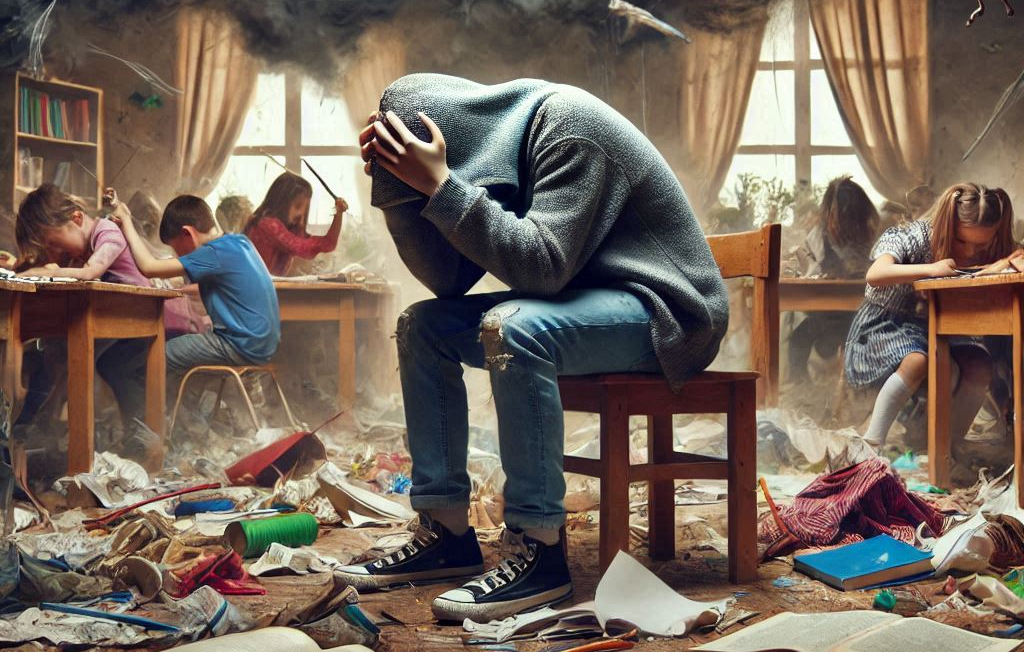
A few years ago, for not the first time, I found myself at the school at the bottom. Test scores were hovering around 18 percent proficiency, chronic absenteeism was rampant, and the school had the reputation of being the most dangerous in the district. You couldn’t take a tour of the school without encountering the smell of vapes, and sometimes marijuana and alcohol in discarded red solo cups, or getting stared down by a child, or hearing the most offensive and derogatory language. Students would roam the halls in packs between lessons, banging on the windows of the classrooms and disrupting the learning. Walk into a classroom and there would inevitably be a group of kids clustered in the back, socializing around their phones and unabashedly disregarding their teachers. Oh, the phones, and the noise, and the Takis. Blue Taki and Red Hot Cheeto dust caked on fingers and phones, and candy wrappers and trash strewn about the hallways.
Then, one week, a series of coordinated fights was organized on the students’ phones. I’d be standing in the hallway dealing with some kid who destroyed all the paper towel dispensers, or was caught sharing porn in a text chain containing 200 students, and suddenly the doors of multiple classrooms would open and kids would run out cackling in the most disturbing fashion to gather in the courtyard or a neighboring park to watch their peers beat each other up. Your mom said this about my mom or dad or sibling, etc., etc. I will violate you physically, sexually, I will kill your whole family. The police would be called, and someone would spend the night in juvie. The rest of the kids would return the next day with plans of revenge.
This would happen over and over again in a never-ending cycle. It wasn’t until a child brought an airsoft gun to school and started shooting up the halls that teachers threatened a walkout, and the district was forced to intervene.
The (Temporary) Intervention
Faced with a union and PR nightmare, the district sent in a team of 15 of their higher-ups, each armed with radios. The intervention was nothing short of intense. The district folks were stationed at every stairwell and bathroom entrance; the hallways immediately began to echo with the constant barking of orders to get to class, or else face immediate suspension. Announcements blared over the intercom at all hours, creating an atmosphere of constant vigilance. Seating charts were implemented and enforced, and junkfood and phones were banned: If we see it, we take it. The officials patrolled the hallways with an intensity that left no room for misbehavior. The once chaotic environment was now under a strict regime, and the students quickly learned that the days of roaming freely and causing disruptions had come to an end.
The intervention was unrelenting, but it was exactly what the school needed. Slowly, order began to emerge from the chaos, and the school started to climb out of the depths of its despair. After two weeks, the principal addressed the students on the progress that had been made.
“I know that this has been difficult, but it was a long time coming. The days of this school being unsafe and chaotic are over. Welcome to your new school.”
This declaration was followed by a standing ovation from the students, a moment that still gives me goosebumps.
A Return to the Bottom
The intervention I just described was heavy-handed, but it transformed the school. In one year’s time, the school nearly doubled their results on standardized tests, the substitute teachers started returning, and the turnover of staff practically disappeared. While initially strict, the strictness began to subside and be replaced with playful banter and restorative conversations. Teaching was allowed to occur, although it continued to be an uphill climb to building students’ confidence when many could barely read. For me, the most important data point came from talking to the kids, who we know love to compare.
“Yeah, we used to be the worst school,” you’d hear them say to each other. “But now McCarver and Roosevelt are the worst schools. I’d never go there.”
The influx of warm bodies from the district was certainly helpful, but do the math on 15 salaries, and it was clearly unsustainable. Eventually, the district people needed to return to their offices, where they could once again do office stuff. It was now up to 1 principal, 2 assistant principals, 3 counselors, 1 dean of students, 1 instructional coach, 45 teachers, and 8 paraeducators, to maintain the system we’d created during the intervention. This system included:
- Everyone Standing at Their Doors: Teachers and staff present at classroom doors to greet students and monitor behavior.
- Hallway Sweeps and Monitoring Between Lessons: Ensuring that students are where they need to be and reducing opportunities for misbehavior.
- Procedures for Transitions Between Class Periods: Implementing clear procedures to manage student movement and reduce congestion.
- Starting on Time with a Do Now: Engaging students immediately with a task as soon as they enter the classroom.
- Explicit Teaching Methods: Using techniques that increase student participation and keep the pace of the lesson brisk and lively.
- Bell to Bell Teaching: Maximizing instructional time by keeping students engaged from the start to the end of the class.
- Merit/Demerit System: Implementing a system to reward positive behavior and address negative behavior.
- Instant Removal from Class for Low-Level Disruption: Admin a call away to remove students from the classroom to allow the other 29 students to learn.
- Centralized Detention System: A consistent and fair system for addressing behavioral issues.
- Banning Phones: Prohibiting the use of phones during school to minimize organized fights and keep students focused on learning.
To ensure this system was successful, we needed complete alignment and coordination between staff. If one hallway decided to do things their way, students would soon find out and exploit that inconsistency. Similarly, if some teachers became lax on phones, word would spread, creating a constant battle between the “strict teachers” and the “cool teachers who allow phones.” My Steplab colleague, Peps Mccrea, created an excellent video on how the best schools secure lockstep alignment and codification of strategies.
At first, we were able to make our system work without outside support. The teachers understood there was nowhere to go but up, so they agreed to collaborate. They also enjoyed teaching more when they were freed from constant disruptions and threats to their safety. As a result, teachers became much more receptive to coaching, allowing leaders to get hands-on in ensuring the agreements we had made as a school were implemented with fidelity.
But, over time, the system started to fall apart. Some teachers began refusing to stand at their doors, escort their classes to the cafeteria, or take on any hallway sweeping duties, citing their contract language around supervision. Personal preferences got involved, and leadership had other responsibilities and began dropping the ball as well. Some staff simply couldn’t handle the constant monitoring of behavior; the maintenance of incentives and rewards; the workload of calls home, duties, and detentions.
This is your third warning to put your earbuds away. Fine, if you don’t want to learn, I won’t teach you.
It was exhausting, and as soon as it got out that others weren’t holding up their end of the bargain, even the most dedicated and consistent staff members returned to their old ways. In just a few years, the school reverted to its former state.
Conclusion
Our greatest embarrassment in education is that we allow the schools plagued by the worst behavior and academic performance, which also tend to serve our most impoverished communities, to languish in failure. It’s embarrassing because we know how to turn these schools around.
Public education is at a crossroads. To truly support our most disadvantaged schools, we must implement proven strategies and overcome the barriers that prevent their implementation. In the case of the school I just described, two things ultimately doomed its success: inconsistent enforcement of policies due to personal preferences and union interference, and a lack of robust staffing, including administrators, hallway monitors, paraprofessionals, and other staff members dedicated to supporting teachers with behavior. In other schools I’ve worked in, the fault lay in a refusal to implement tried-and-tested strategies due to a steadfast adherence to romantic beliefs about childhood and behavior. While it would be wonderful if students could thrive in unstructured environments, free from external pressure from adults, they simply cannot and never will.
It is time for a renewed focus on effective, evidence-based practices that prioritize academic excellence and accountability.
Discover more from Education Rickshaw
Subscribe to get the latest posts sent to your email.


 Education Rickshaw
Thank you for telling this. I think that a lot of us hear about these situations third- or fourth-hand, and not wanting to believe the worst of kids, put up a wall around the knowledge, forever unsure of whether to trust it. Hearing this from someone who was there (and who’s built up so much trust over the years) changes that.
And the ironic end puts the situation in a different mental model: I think we usually hear these school disasters stories from the frame of (A) “and the district just lets this linger” or (B) “and then everything turned around”. This is a new fail state for me, at least — gives much more to reflect on.
Again, thanks!
LikeLiked by 1 person
I just quit a school that was like this. Here in CA, the state superintendent of public instruction sent out a letter a few years ago that’s been interpreted to mean punishment is racist and there are better alternatives that we should use. Our principal took this to heart and basically eliminated punishment. It was all carrots, no sticks. Teachers frantically attempted to entice students to behave by throwing special events, issuing rewards points, giving out candy, creating easy/fun lessons like word searches and coloring activities, “building relationships”…anything but punishment or even a stern tone. The positive tone is wonderful, but alas a significant percentage of students take advantage of the niceness and do whatever they please. The result is a chaotic environment that is incredibly stressful for all but the aggressive extroverts. I’ve heard people compare these schools to failed states. I think the comparison is apt. Rule of law has broken down.
LikeLiked by 1 person
After 20 years teaching in a well run and academically successful school I thought I would try teaching somewhere different to acquire some new skills. I was not well prepared. My new school has new and first class facilities, fantastic staff, but the behaviour of students and lack of engagement contributed to stress levels that saw my body respond to by having a heart attack. So after a one year struggle, with 40 days on sick leave, I transferred to a settled and established school. The intentions were excellent were I was teaching, but the emphasis upon student well being and positive rewards seemed to facilitate a lack of engagement and low academic results and unhealthy stress levels on staff. I learnt a lot professionally, but after being use to being able to teach and then having this denied due to behaviour I found this very difficult to cope with.
LikeLiked by 1 person
Fascinating piece. The most important takeaway is what you noted: what works is consistent enforcement and punishments (yes, I dare say this word instead of “consequences”) for breaking the rules.
But in the “re-failure” of the school has another important lesson: any solution that involves telling teachers to do more work in the same amount of hours for the same amount of pay, simply isn’t going to work. That seems to me the real reason for the relapse.
And it is not as though the money to arrange for sufficient staffing doesn’t exist. But there is a question of priorities: is it more effective to spend money on twenty layers of education bureaucrats doing “office stuff,” or to instead spend that money on half as many hall monitors? What is actually going to help learning?
A last question: was expulsion possible at this school?
LikeLike
This is very similar to what I have experienced in the UK. We have a lot of strategies which we know work but are let down by inconsistency. My question is what the influence of the particular community is on the nature of behaviour. Here, the worst achieving social / ethnic group is white British students from deprived backgrounds. That is who we were working with and struggling. The combination of staff inconsistency over time and student intransigence is a toxic mix. The solution does seem to be carrot and stick but somewhere along the line we have to engage with the issue of motivation. Why are these students not engaged in school? We have had some success here through 1:1 relationships between support staff and students. The issue is having enough support staff which can only be achieved by increasing class sizes to make up for having less teachers. I believe there is a solution here but it takes courage and character to put it into effect.
LikeLiked by 1 person
I spent 3 years in a school that very much aligns with your description. One factor that I saw saw play out is that the stress of that environment led to high staff turnover and even unfilled positions. This makes it hard to maintain any system. The only way to turn things around in these schools is for leadership to make it a priority (and probably get union buy-in on certain policies). I do not see this happening anytime soon given the current ethos of ‘enforcing rules is bad and racist’.
LikeLike
Elsewhere online people were bothered by my suggesting there was “union interference.” I don’t know how else to call telling teachers they don’t have to stand in the hallway if they don’t want to. Yes, it’s exhausting, but give me 14 paras and I’ll still have teachers stand out in the hallway at a tough school.
LikeLike