A possible barrier to the science of learning movement is that there are potentially a lot of research terms and definitions that need to be learned in order to communicate clearly with one another.
On the one hand, the pursuit of a shared language among educators is worthwhile. If when you say productive struggle, I assume you mean “explicit teaching undermines learning,” but you actually mean “I have students try hard on problems that I’ve explicitly taught them,” then we’re going to talk past each other—each of us frustrated that the other can’t understand the very simple idea we’ve each assigned to the same words.
On the other hand, how much new jargon do educators really need? Do we need to know specific brain structures like the dorsolateral prefrontal cortex or the hippocampal formation, or is “working memory and long-term memory” enough? Do we even need those terms, or is it sufficient to say, “Novices overload quickly; experts use prior knowledge to reduce load”? But then—how are novice and expert defined in the research?
The truth is, we’re in new territory here. My personal approach is to avoid teaching a bunch of new jargon unless a term genuinely shortcuts the conversation and helps us understand each other better. I’ll use element interactivity as an example here, and you can judge for yourself whether it earns a place in our shared vocabulary.
New Word: Element Interactivity
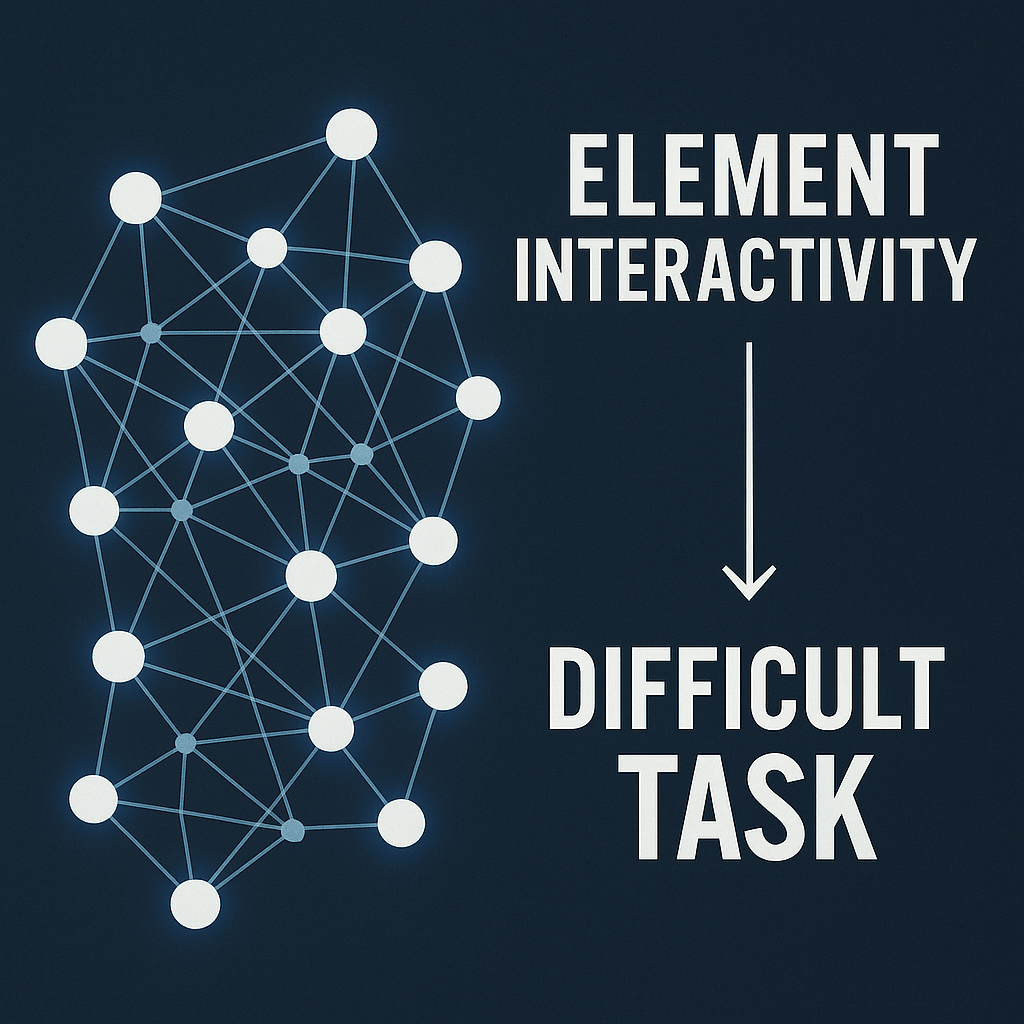
We all know that some material is easy and some is hard. One way to think about that difficulty is by considering how many distinct pieces of information—elements—a task contains and how many of them need to be processed together.
Memorizing a date or a definition involves relatively few elements. Solving a multistep problem, by contrast, involves far more elements—more steps, more decisions, more pieces of information that have to be coordinated.
But it’s not just the number of elements that matters. It’s the relationships, or interactivity, between those elements. Some tasks require you to hold multiple pieces of information in mind at once and refer back to earlier steps. That interdependence is what makes a multi-step math problem high in element interactivity, while memorizing a list of unrelated words is relatively lower in element interactivity. Even if both tasks contain the same number of elements, you don’t need to coordinate the meaning of word #1 in order to learn word #2 when memorizing a word list.
In addition, prior knowledge radically changes element interactivity. An expert musician who can read notation fluently is not overloaded when handed a new piece of music—so long as it’s within their expertise. But someone who’s just learning to read music will find the same task overwhelming. The novice must process every element; the expert’s prior knowledge compresses multiple elements into a single chunk. Knowledge is power, baby.
A Simple Example
So, is reading a sentence like “Sam sat on the mat” high or low in element interactivity?
For a brand-new reader: High in element interactivity. They must decode each phoneme (/s/, /a/, /m/), blend the sounds, hold the words in working memory, and decipher what they mean together. Many elements, many dependencies.
For you and me: Low in element interactivity. If you can read this blog, your prior knowledge enables you to process the entire sentence automatically and easily, almost as a single, effortless unit.
That’s the essence of element interactivity: the complexity of a task is always relative to the prior knowledge of the learner.
What terms should teachers know?
Should teachers know the term element interactivity?
I’m not sure. I personally don’t use it in trainings with teachers.
Should teaching be informed by the underlying idea—that task complexity and student expertise interact, and that this interaction should guide how we calibrate scaffolding and sequence instruction?
Absolutely.
Science of learning terms give names to phenomena teachers already observe every day. Ironically, if element interactivity teaches us anything, it might be that we should consider cutting it from the list of things we expect teachers to learn. The more unnecessary jargon we strip out, the more cognitive bandwidth teachers have to focus on what actually moves learning.
Whether we keep certain terms or toss them, the point is this: time is short, the stakes are high, and kids need us to design instruction that aligns with how learning really works. That’s the part we have to get right.
Discover more from Education Rickshaw
Subscribe to get the latest posts sent to your email.


 Education Rickshaw