I recently started this series about motivation and Direct/explicit instruction. So far, it has looked at key delivery and design considerations, such as brisk pacing, praise, and obtaining high success rates. These are useful as goals for individual teachers, but on their own, they miss what the best schools do to motivate whole groups of students. For this, it is more accurate to describe system-wide motivational models than specific motivational techniques.
Those with a pulse on what goes on in challenging schools understand that motivation begins with behavior. Students can’t enjoy lessons when they’re beholden to dysregulated peers and bullies. Safety and predictability aren’t “extras”; they’re prerequisites for attention, effort, and trust.
While many schools I visit require very little cooperation between staff, schools that take a whole-school approach to behavior tend to operate as teams. They don’t treat expectations as a matter of personal style or adult preference. They agree on routines, teach them explicitly, and reinforce them consistently across settings.
One of the schools that I consult with recently implemented a v1 of a “behavior curriculum” built around a specific set of agreed-upon routines. Those routines interfaced with cafeteria staff, hallway monitors, para-educators, and intervention settings, so students weren’t constantly forced to decode a new set of rules every time they crossed a threshold. The behavior curriculum’s intent wasn’t purely motivational, but it had motivational effects: students knew where to go, what to do, and what to expect in each setting in the school. As a result, students start to associate school with something worth showing up for, because the systems protect them from the chaos that makes school feel pointless.
Where schools don’t do this—as you can read about here—motivation dies. Why invest effort in a lesson when you can’t count on the room to hold steady long enough to learn?
Wisely, many schools pull another important lever of motivation: they use an acknowledgement or reward system of some sort. Students might earn merits and demerits, race against their teacher in the Student-Teacher Game, or earn small tokens for good behavior, such as puffballs or tickets. Typically, these representations accumulate into more exciting rewards and experiences, such as entry to a dance party or lunch with a teacher.
Again, such systems can only succeed when staff put on their adult pants and work together as a team. In schools where they fail, you’ll find a minority of teachers using the rewards as intended while the majority don’t. Some compromise the system by dramatically inflating the rewards; others sabotage it by openly expressing their opposition to “extrinsic motivation.” But children thrive on positive reinforcement, and they will often do things they otherwise wouldn’t do for a little bit of it.
In other schools still—such as those using a Direct Instruction “immersion” model—folks understand that children are highly motivated by visible progress and clear proof they’ve mastered a skill. The problem with most schools is that they don’t use, or even understand, mastery learning, so students can’t really be motivated by it. In your typical school, almost all learning, with very few exceptions, is meant to occur through exposure or “coverage” teaching. Students move through lessons based on vague skills and unmeasurable outcomes in heterogeneous groupings, advancing based on seat time rather than mastery.
When there are no clear mastery thresholds, no reliable feedback loops, and no satisfying sense of “I did it,” mastery cannot function as a motivational engine. Instead, the implicit message becomes: try hard and you’ll probably be fine. But also: if you don’t try hard, you’ll probably still be fine. You can show up, do the minimum, let the bright kids carry the discussion, and coast through most of the day.
If everything happens independent of effort—no immediate friction, no meaningful correction, no structured reteach, no expectation that you must get it—then the rational move is to save your energy for something else. And once that becomes a habit, it’s not just that the student isn’t motivated by mastery; it’s that the school has trained them to see effort as optional.
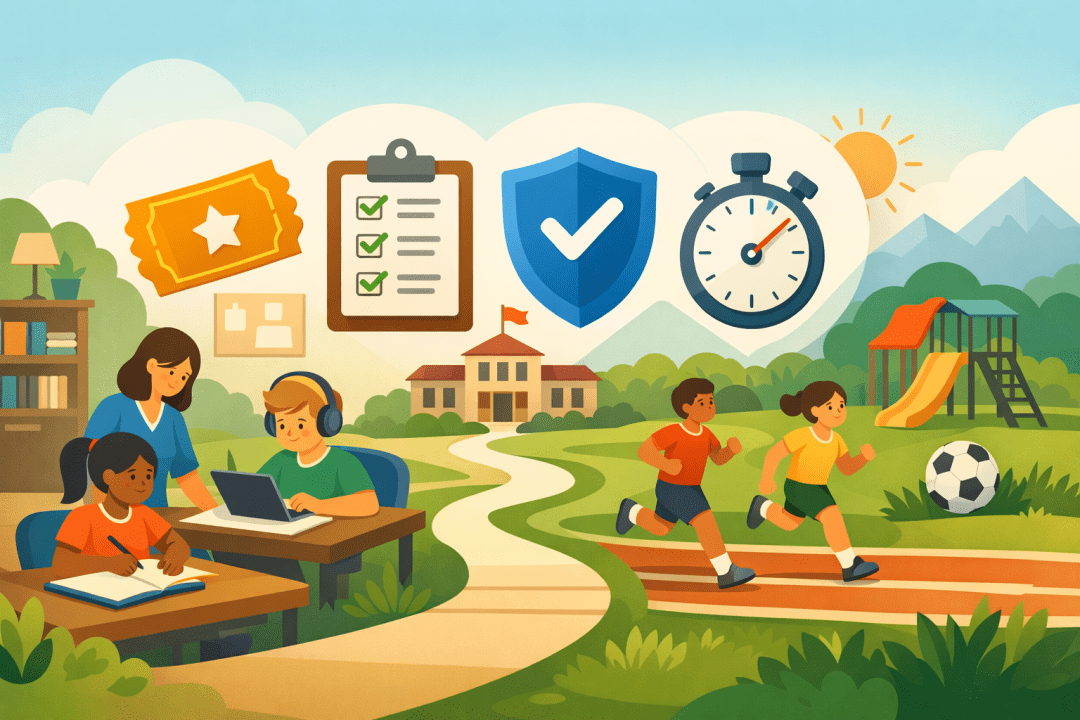
Now, let’s combine the three areas I’ve outlined so far into a motivational model:
- A system for making learning safe and predictable
- A system for acknowledging and rewarding effort
- A system that orients students towards mastery goals
I’ve visited a lot of schools, and I’ve seen these ingredients show up in wildly different forms—shaped by a school’s context and values—and still motivate the heck out of kids. I’ll focus on one example that’s been hard to ignore lately: Alpha Schools.
Alpha has been making the news recently for its use of AI-based platforms to teach the core subjects. Instead of focusing on the apps, I want to zoom in on Alpha’s motivational model.
In Alpha schools, students enjoy a rather unusual schedule of “mornings on computers, afternoons in something cool.” This sets up an essential part of the motivational model: “Time Back.”
In Alpha’s Texas Sports Academy, for example, when students complete their academic responsibilities, they earn their time back to play sports. The theory goes that a child who would rather do nothing else than chase a ball will be willing to “grind out” their academics—provided they are placed appropriately and taught effectively—if they can recuperate the rest of their day for sports. As you can imagine, the model leverages the benefits of self-selection: students who come to Texas Sports Academy really, really, really want to play sports all day.
Personally, I don’t think my oldest daughter would be especially compelled to earn her time back there, because she hasn’t shown a great interest in sports. We have no idea about our youngest daughter just yet.
Somewhere my daughter would be much more “inclined to grind” would be Alpha’s Waypoint Academy. There, students do two hours on computers in yurts in order to earn time in the wilderness—doing the equivalent of what Texas Sports Academy does for sports, but with outdoor education: shooting arrows, fishing, using compasses, climbing trees.
It’s no small thing, Alpha’s “Time Back” idea, but it would be a bit superficial if you didn’t account for something essential: Alpha has thought deeply about mastery learning, and it’s the engine of the model.
Every day during their morning academic block, students are given computer-assisted Direct Instruction lessons that teach them extremely efficiently. Students are placed into subjects by level, not age—which is motivational in itself, because the work is challenging without being over their heads. Embedded in the apps are the principles I talk about regularly on this site: cognitive load theory, high rates of student responding, constant and immediate feedback, and desirable difficulties. Supporting it all is the strong presence of extremely well-trained teachers, or “guides”, whose entire job is to motivate children to smash their mastery goals.
Sure, students earn points for mastering stuff. Yes, there are rewards for achieving milestones, like having lunch with the guide of your choice. But there is also a wraparound culture of high expectations and high support from adults who work together as a team.
We know you can crush this. We believe in you.
Do it for points, do it for rewards, do it for the team, do it to earn your time back—and do it for its own sake if you wish. But the model is designed to pull all motivational levers when it comes to academics, because this stuff is hard, and not every subject is intrinsically rewarding for every child.
Motivation is shaped by a multitude of factors that interact with and amplify one another. “High expectations” breaks down when “hard” isn’t the same for everyone—when some kids are bored to tears doing something they already know how to do and others find it impossibly difficult; and perhaps the hardest part isn’t the material but getting through the lesson while your peers clown around. Well-intentioned reward systems fail when the reward economy isn’t coherent—Some teachers hand tickets out for free, others ration them, others build their own separate economy. And even when the system is consistent, it can still collapse if the payoff isn’t actually that desirable.
The elephant in the room when it comes to Alpha is how it redefines the role of the teacher into that of a motivator. Teaching has always been a complex job, but in recent years we’ve been asking teachers to be instructional designers, performance artists, subject-matter experts, bouncers, part-time therapists, differentiation wizards, parent-diplomats, paperwork jockeys, AND motivational hype-men—and then we act surprised when we can’t retain teachers or improve instruction at scale. When you really think about it, Alpha’s theory of change is not so different from that of DISTAR: design the adult role around management and motivation, and outsource the instructional design to Engelmann and Carnine.
As a student of excellent schools, I can’t help but conclude that the secret sauce isn’t any single technique—it’s coherence. When adults row the boat together, using the same techniques, routines, and procedures—as in schools like Baltimore Curriculum Project, Steubenville, TELRA Institute, and now Alpha—motivation stops being a personality trait. It becomes a product of the model and the system.
Discover more from Education Rickshaw
Subscribe to get the latest posts sent to your email.


 Education Rickshaw