
I recently started teaching with two Direct Instruction programs. The first is Corrective Math, which I am using to teach basic fractions to a group of five middle school students. The second is Teach Your Child to Read in 100 Easy Lessons, which I am using to teach beginning reading skills to my 4 year old daughter.
I am a total novice with these materials, but for years I have been reading about the principles that underlie DI. These map closely to general principles of explicit instruction, such as collect responses from all students, use models and guide practice, correct errors, and provide lots of review. Perhaps the most controversial feature of all DI programs is that they require teachers to use a script.
Before I started teaching with DI programs, I figured people shouldn’t knock the scripts until they tried them. After using the two different scripts for a few months, I’m here to tell you that they are nothing to get worked up about.
The format of both the scripts is the same. The words the teacher says are in color and the directions for what to do (i.e., write on the board, point to a letter, repeat until firm, etc.) are in black. It takes about 5 minutes to prepare for a 20-30 minute lesson. A few minutes before the kids come in, I read the script aloud and practice doing what it says.
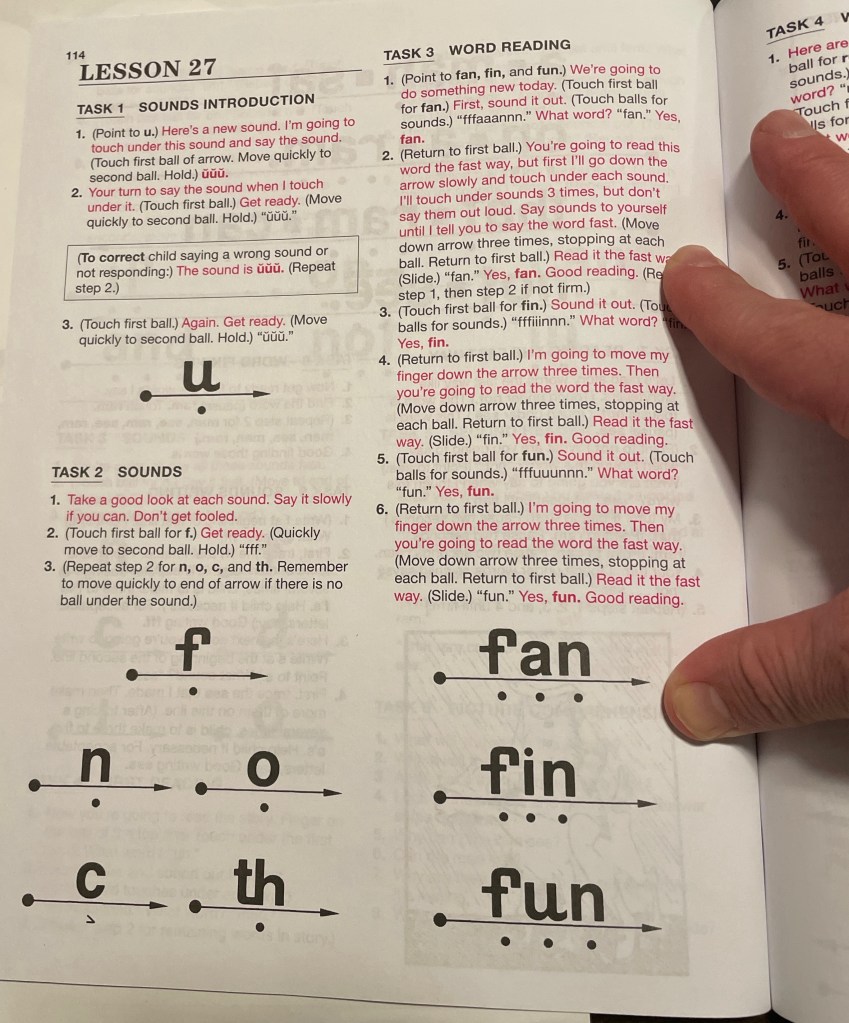
When I first started using these materials, I was worried I wasn’t making enough eye contact with the children. To counteract this, I would look up so frequently that I would lose my spot on the page. I learned to keep my finger on my place in the script and to do extra rehearsal of the key lines for the day’s lesson (“How many parts are in each whole and how many are used?”). I also learned from watching video of myself that my eye gaze looked fine from the students’ perspective. With a bit of practice it’s becoming second nature.
Listen and subscribe to my podcast on…
Spotify
Google Podcasts
Apple Podcasts
WordPress
Often when I talk about scripts or “canned” curriculum materials in general, teachers will leap out of their socks to defend their autonomy. They tell me they are two things at once that cannot both be true. They tell me that 1) they are skilled professionals and 2) they are not skilled or professional enough to be able to read a script without sounding like a robot.
It’s curious.
Discover more from Education Rickshaw
Subscribe to get the latest posts sent to your email.


 Education Rickshaw
My experience (15 years in primary ed) is that some teachers will get worked up about absolutely everything, and some don’t even realize what’s worth getting worked up about (not sure which is worse).
But as far as canned scripts- we’ve had, and currently have- programs like this, and they can seem daunting at first. Then you start to get the hang of it, and you realize, after using the program for a year or two, which parts are really key and should be stated verbatim and which parts you should put more or less emphasis on, depending on the kids you have in front of you. No program is perfect, but as a teacher hones her craft, the program and teacher can kind of “meld together’ to deliver the content that is needed for those students to progress. As a newer teacher, being asked to teach phonics explicitly and systematically, I am so thankful now that a scripted program was bought for us about 10 years ago. I learned so much from prepping to teach those lessons that I never learned anywhere else.
Thank you for allowing me to comment!
LikeLiked by 1 person
Distar adds unnecessary confusion for me. Were the studies into the effective of this orthography conclusive? I prefer the short stories in regular script from Lesson 70 or so onwards tbh.
The actual scripts though… they don’t bring much to life!
LikeLike
This is maybe interesting (haven’t read it in full https://eric.ed.gov/?id=ED071018
“They don’t bring much to life” – I watch teachers teach for a living. Same is true for the bottom quartile of all teachers, except add that they confuse the heck out of students with discontinuous/ambiguous/unnecessary wording.
LikeLike