

Welcome back to Progressively Incorrect and to the season 3 Finale of this podcast. In this final episode before I take a break for the summer, we are going out with a bang by bringing back one of the most respected and influential cognitive psychologists in the world, Paul Kirschner.
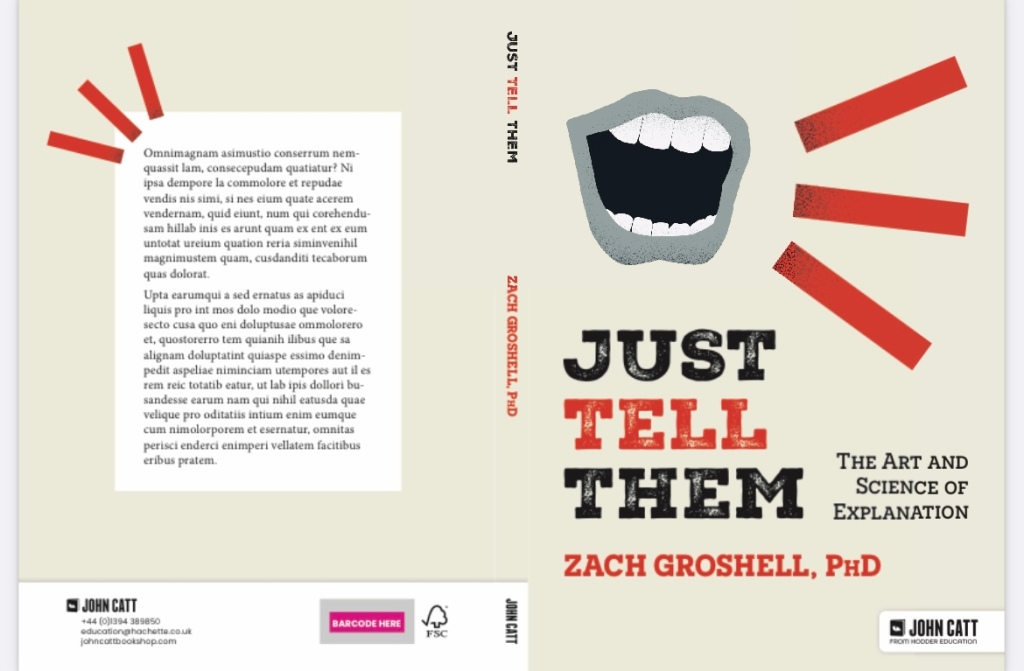
Before we go over to Paul, I wanted to thank all of you for supporting me and this show. This season, I was able to interview 31 fabulous guests, and I hope that their insights and research helped you grow and perhaps even improved your teaching. You’ll be happy to know that, along the way, the number of listeners of Progressively Incorrect has grown exponentially, which has led to a lot of opportunities for me. John Catt from Hodder Education became a sponsor of this show, and at about the same time I signed with them to write a book. It may be too early to share this, I don’t know, but the book is titled, “Just Tell Them” and it is all about how to model and explain your content area explicitly and directly. If you go to the show notes of this episode, you will find an early design of the cover art, which has a nice pop art vibe that I really like. Look out for the release of “Just Tell Them: The Art and Science of Explanation” sometime next school year.
My other announcement is that, after taking a long walk into the meadow, I’ve decided to quit my day job to give full-time consulting a try. Schools have been asking me for the past two years to help them bring evidence-informed practice to their teachers, but I’ve been unable to accommodate all the requests while also having to report to a brick and mortar building. While it was hard to say goodbye to my middle school and all the wonderful people there, I am excited about the new adventure ahead of me. My August is already packed with training gigs in North Carolina, Colorado, and New York, and I will be keynoting at researchED Chile in the fall, among several other opportunities. In shifting my time and energy to this work, I hope to be able to play a larger role in improving learning and instruction across this country.
Alright, that’s enough from me, please join me in welcoming Dr. Paul Kirschner back onto the show to update us on the latest debates over inquiry and explicit instruction.
Papers referenced in the podcast:
The original paper by Zhang et al.
The response from de Jong et al.
The response to the response by Sweller et al.
Discover more from Education Rickshaw
Subscribe to get the latest posts sent to your email.


 Education Rickshaw
Paul’s claim that De Jong et al.’s studies are dismissed because they are program-based and involve multiple variables seems inconsistent. Project Follow Through and Rosenshine’s studies are also program-based and involve multiple variables. For example, Project Follow Through featured small class sizes (around six students), homogenous groups, and significant professional development. Paul argues, “If you vary more than one thing, throw it out.” Why isn’t the same standard applied to Follow Through?
Additionally, the assertion that “most, if not all, of the productive failure research has been conducted by the same person, and when it doesn’t work, that person was not involved” is incorrect. Ashman and van Merrienboer list numerous studies conducted by different researchers.
Paul dismisses and belittles Goal-Free Problems but fails to mention that both Sweller and van Merrienboer advocate for them. For example, Sweller stated, “A heavy use of worked examples can provide learners with stereotyped solution patterns that may inhibit the generation of new, creative solutions to problems…For this reason, goal-free problems and completion problems…may offer a good alternative to an excessive use of worked examples.”
.”
LikeLike
I don’t even know where to begin with this one. Let’s just go to the last paragraph- Paul belittles Goal Free Problems. No he didn’t. Now take that and apply it to the rest of your “analysis” – the rest is equally flawed.
LikeLike
ok, I’ve listened again, maybe you are correct about goal free problems (@31mins). Paul might only be mocking goal free problems in the context of productive failure, but it is ambiguous.
Also, important to clarify that despite their name, goal free problems do have nonspecific goals, (“find as many angles as you can”) rather than specific (“find angle x”).
My 1st point was not an analysis but a simple and important question; you dismissed program based studies cited by De Jong et al, because they vary too many things. (@30mins, “vary more than one thing, which means throw it out, throw it away”). Why don’t you apply the same standard to Project Follow Through?
My 2nd point attempted to challenge Paul’s claim (@29mins), that “most if not all the productive failure has been done by the same person & when it does not work that person was not involved”. But, the 2 researchers used in the podcast do cite a number of individual studies from different people,
Ashman:
“A number of studies directly support the relative effectiveness of problem solving first when compared to an explicit instruction approach (e.g. Kapur, 2012; Loibl & Rummel 2014a, 2014b; Kapur 2014; Jacobsen, Markauskaite, Portolese, Kapur, Lai, & Roberts, 2017; Lai, Portolese, & Jacobson, 2017; Weaver, Chastain, DeCaro, & DeCaro, 2018).”
Gorbunova, van Merrienboer, Costley 2023:
“However, there is contradictory evidence showing that some inductive instructional methods such as productive failure (Kerrigan et al., 2021; Loibl & Leukel, 2023; Sinha & Kapur, 2021; Trninic et al., 2022) can improve learner performance and at the same time
reduce cognitive load (Niu et al., 2021).”
LikeLike