

Last week I attended a government-sponsored training on instructional video that began with three weird reasons for why teachers should use more instructional video: Instructional videos cater to students' learning stylesInstructional videos are more popular with students (i.e., they like them) than alternative methodsInstructional videos are the future of learning I'm sure fans of this … Continue reading Instructional Videos: Perfect for Learning Styles, Popular with Students, and THE FUTURE of Education!


Cringe!
My last blog post seems to have been this site’s 200th post. What a journey it’s been. Long time readers may have noticed that Stephanie (my wife) used to contribute about half of the posts on educationrickshaw.com. Lately she’s been too busy being one of the best literacy specialists in the country to be messing … Continue reading Cringe!


Can a Theory Improve Your Teaching?
If much of what we learned in teacher training was not very useful once we got to the classroom, and if some theories we were taught, like learning styles, were just plain false, it's tempting to conclude that theory has little to offer the busy teacher. Having used cognitive load theory to streamline my teaching, I can't agree.


Beliefs, Evidence, and Educational Technology
Frequent readers of this blog will know that I am the Director of Educational Technology at a 6-12 independent school. My role is to design and implement the strategy around online learning and train teachers how to integrate various online tools into their lessons. This post is a reflection on whether my beliefs about teaching … Continue reading Beliefs, Evidence, and Educational Technology

PD Opportunity on Cognitive Load Theory
As readers of this blog will know, I've recently been writing a bit about cognitive load theory and how it's led to changes in my thinking and teaching. I debated some of its foundational ideas on a recent podcast, as well. After presenting on CLT in the fall, NWAIS asked me back as part of … Continue reading PD Opportunity on Cognitive Load Theory


Is Working Memory Fixed or Can it be Trained?
Many teachers allow students to play "brain games" as part of the curriculum. When I say "brain games", I'm referring to short - often fun - activities that are unrelated to the core content, but which are thought to engage the mind or make you smarter. When I was a student, if I finished my … Continue reading Is Working Memory Fixed or Can it be Trained?

Videos, Podcasts, Infographics, and Articles for Bringing Research into Practice
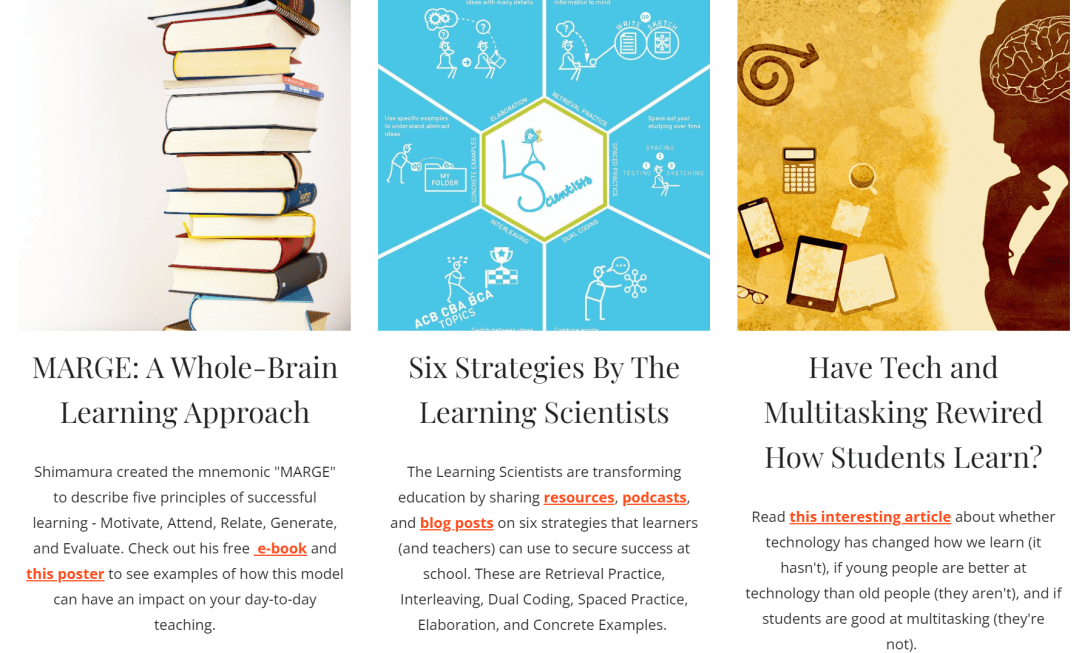
Many educators are eager to learn about evidence-based practices but don't know where to start. One barrier is that most research articles are paywalled, which requires teachers to buy an expensive subscription or e-mail the researcher in order to gain access to research. Another is that learning how to read and interpret scholarly articles requires … Continue reading Videos, Podcasts, Infographics, and Articles for Bringing Research into Practice


Does More Learning Happen When Students are in the Driver’s Seat?
Most teachers will be familiar with Khan Academy, or similar learning programs, that offer a mixture of 1) problems to solve and 2) instructional supports that students can use to learn how to solve the problems. Common instructional supports in online learning environments include partial hints (e.g., click here for a hint to get you … Continue reading Does More Learning Happen When Students are in the Driver’s Seat?


My Research
In a couple weeks, I will be conducting my first research study at a school in Seattle. Here's a slightly edited version of the post I wrote for their community newsletter. In 1885, Hermann Ebbinghaus discovered that we tend to forget the things we learn at a highly predictable rate. What made the discovery of the … Continue reading My Research


Shifting to Online (again)? Check out this Poster
I am happy my community is back on campus; a beautiful learning space where teachers utilize their physical presence to guide attention and support students towards new understandings. I also realize, having been fooled too may times by COVID, that it’s possible that we’ll be forced to shift once again into a hybrid model (and … Continue reading Shifting to Online (again)? Check out this Poster

 Education Rickshaw
You must be logged in to post a comment.